The range works again after a new igniter, so the repair itself was sound enough. What I did not care for was how little got explained while it was going on. I had to ask twice what had actually failed and why it mattered.
Kathy V.2025-12-05
Independent Viking service · St. Johns County, Florida
$80 diagnostic, credited to the repair
parts
A worn Viking burner is normally fixed one part at a time. Read the serial date, name the failed piece, count the repeats, then weigh what reaching it involves.
Reviewed 2026-10-11
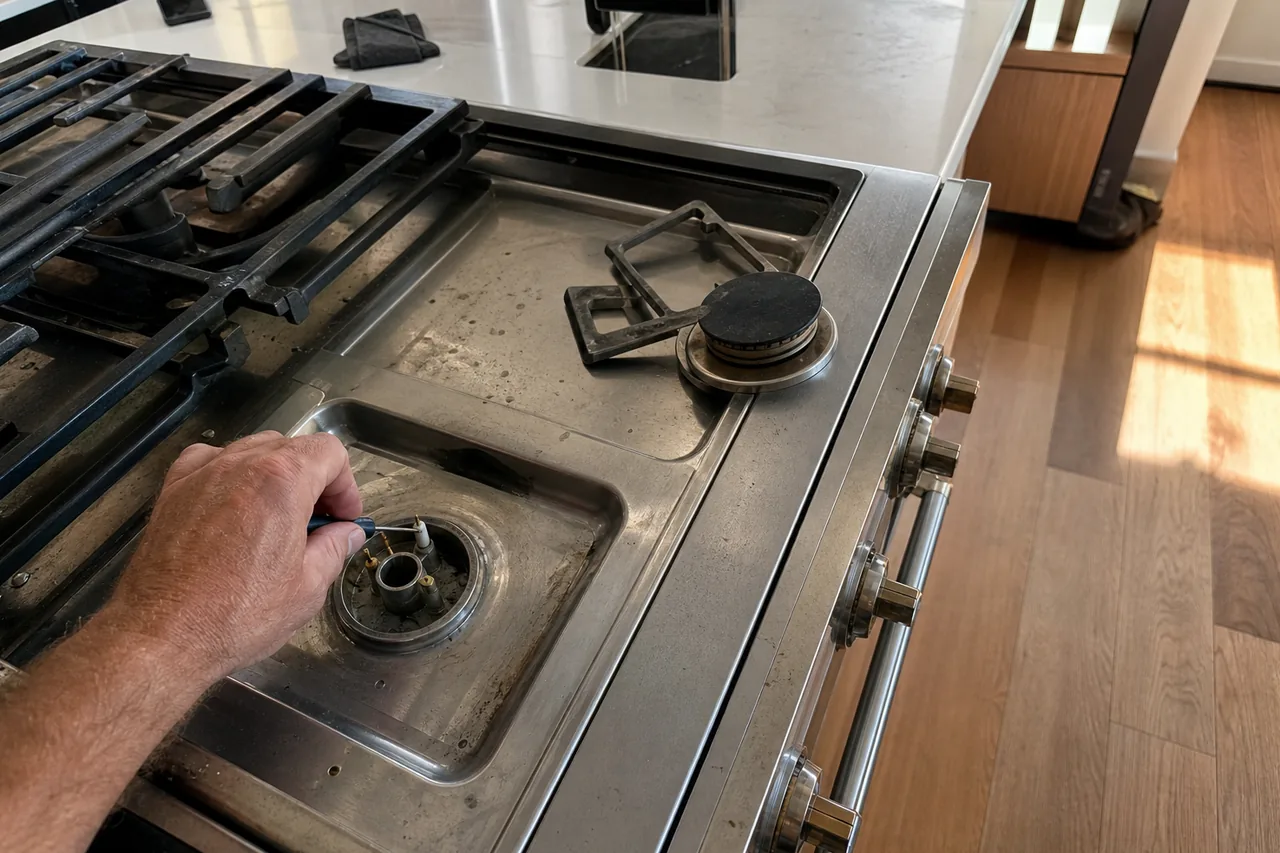
Viking burner replacement is usually a one-part job, not a new range. A sealed Viking burner is a stack of pieces: the cap on top, the slotted head that spreads the flame, the igniter beside it and the valve behind the knob. Each can be ordered and fitted alone. Before buying anything, settle four questions: how old the range is, which piece failed, whether it has failed before, and how much of the range must come apart to reach it.
The serial number tells you when the range was built. Viking uses its first six digits as a month-day-year date, so serial 082421C10019872 belongs to a range made on August 24, 2021. Freestanding 5 Series gas models hide the rating plate in one of three places, so check under the left-front grate support or burner bowl on the side panel, then the oven face frame below the knobs, and finally the strip under the control panel. A 7 Series carries its label beneath the controls as well, reached with the oven door swung down, while a Tuscany shows its plate on the inside wall once the storage drawer is out. Copy the full model number, color letters and gas code included; our page on OEM parts and the data plate explains why.
Age then tells you who pays. For two years Viking covers the range in full, counted from purchase or from the closing on a newly built home, whichever gives you longer. In years three through five Viking still supplies a gas burner as a part, but you pay the shipping and the labor, and that later coverage leaves out ignition parts, burner bases and caps.
Most complaints trace to the parts on top, and several cost nothing to check.
| What you see | Likely cause | What you can check | When to call |
|---|---|---|---|
| Uneven, yellow or lifting flame | Cap sitting crooked, clogged ports | Reseat the cap, clear ports with a straight pin | Flame stays ragged once dry |
| Clicking but no flame | Wet or cracked igniter, cap off-center | Dry the burner with the knob off, reseat the cap | Still no light after drying |
| No clicking at all | No power to the spark system | Plug, breaker or fuse | Power is fine and it stays silent |
| Gas smell or a stiff knob | Valve or connection | Turn it off and open windows | Right away |
That no-clicking check comes straight from Viking’s 5 Series manual, which also notes that the surface burners relight by themselves if a flame blows out while gas is still flowing. For clicking without flame, our igniter page goes step by step.
One failure in five years is wear. The same burner failing twice in a season points to a cause that a new part will not cure: boil-overs soaking the igniter, a cap swapped onto the wrong burner after cleaning, or corrosion. Homes on Davis Shores and Camachee Island sit close to salt water, and pitted burner bases and crusty igniter terminals show up sooner near the coast. When the base under the head is itself corroded or warped, a new cap only hides the damage; that is the point where the whole burner assembly is worth replacing.
Caps, heads and most igniters come out from above once the grates are lifted. Valve work is bigger: the control panel comes off, and a range slid tight between cabinets may need pulling forward, with the gas line disconnected and leak-tested afterward.
Burners are not interchangeable, either. On a 5 Series gas range the standard sealed burners are rated 15,000 BTU, or 12,500 on LP, while models with a TruPower Plus burner run that front-right position at 18,500 BTU on natural gas and 16,600 on LP. A replacement has to match both its position and the gas type. Converting a 5 Series range from natural gas to LP calls for kit LPKPDR01 and is a job for a qualified installer, never the homeowner. See Viking range and rangetop repair for more.
A burner on its own rarely justifies a new range. Replacing an igniter or burner assembly typically runs $210–$560, with the firm figure given after the $80 diagnostic, while a replacement range typically falls in the $4,800–$17,500 band. Replacement makes sense when the burner is one of several failures at once, such as a weak oven and a rusted base pan, when parts for an old model are hard to find, or when you already wanted a different size or fuel. The arithmetic behind that call is laid out in repair or replace a built-in.
A band, not a single number: the firm figure is written down after the appliance has been opened and measured, and a range is what you can act on before that. Parts and labour together, fitted, for the fault described here.
| Repair | Typical range |
|---|---|
| Diagnostic visit | $80 flat |
| Igniter or burner assembly | $210–$560 |
| Oven thermostat or heating element | $180–$610 |
| Control board or touch panel | $410–$980 |
| Refrigeration fan or defrost system | $240–$640 |
| Dishwasher pump or control | $240–$670 |
| Compressor or sealed-system repair | $970–$2,640 |
Flat $80 diagnostic covering the visit and the full diagnostic sequence, credited toward the repair once you approve the work.A written estimate comes before any part is ordered or any labour is billed. The whole published table. Worth fixing, or worth replacing.
The visit is a flat $80 diagnostic, credited toward the repair once you approve it. The repair itself lands in the bands published on this page — igniter or burner assembly $210–$560; oven thermostat or heating element $180–$610; control board or touch panel $410–$980; refrigeration fan or defrost system $240–$640; dishwasher pump or control $240–$670; compressor or sealed-system repair $970–$2,640 — so $80 to $2,640 covers the work described here, parts and labour together. The firm number is written down after the appliance has been measured, never before.
Weigh the repair against the appliance that would replace it, not against nothing. A $970–$2,640 sealed-system job under a $9,500–$17,500 column is usually worth buying; the same money into a cabinet that has already had two unrelated faults is not. The $80 diagnostic buys that judgement in writing.
Flat $80 diagnostic, credited toward the repair when you approve the work. If you decide not to go ahead, the diagnostic stands on its own and you keep the written estimate, including what was measured and what was ruled out.
90 days on our labour and 365 days on the parts we supply. Genuine OEM parts. A return visit on the same fault inside the term carries no second diagnostic and no trip charge.
Ring the bench and describe the symptom. A question that cannot be answered on the telephone is a question that needs a meter on the appliance, and we would rather say so than sell a visit to find out.
The range works again after a new igniter, so the repair itself was sound enough. What I did not care for was how little got explained while it was going on. I had to ask twice what had actually failed and why it mattered.
Kathy V.2025-12-05
The oven door on the range sagged and heat spilled out of the top corner. He changed both hinges and the seal, then checked the door for square with a gauge instead of judging it by eye.
Emeka B.2026-02-26
The simmer setting was not simmering and everything scorched. He adjusted the low flame screw on each burner, then held a pan of water at a bare simmer on all of them before he called the job done.
Solveig T.2026-05-09
Flat $80 diagnostic, credited toward the repair when you approve the work. A written estimate comes before any part is ordered or any labour is billed.
90 days on labour, 365 days on parts, genuine OEM parts only. Calls placed after hours are returned the next working morning.