Freezer frosted along one side and the shelves stuck fast. He checked the seal with a slip of paper, found one corner letting air in, and refitted the gasket so it closes evenly across the whole face.
Owen K.2026-04-02
Independent Viking service · St. Johns County, Florida
$80 diagnostic, credited to the repair
refrigeration
Columns, side-by-sides, French doors and undercounter units. Sealed systems, defrost faults, ice makers and door alignment.
Reviewed 2026-08-18
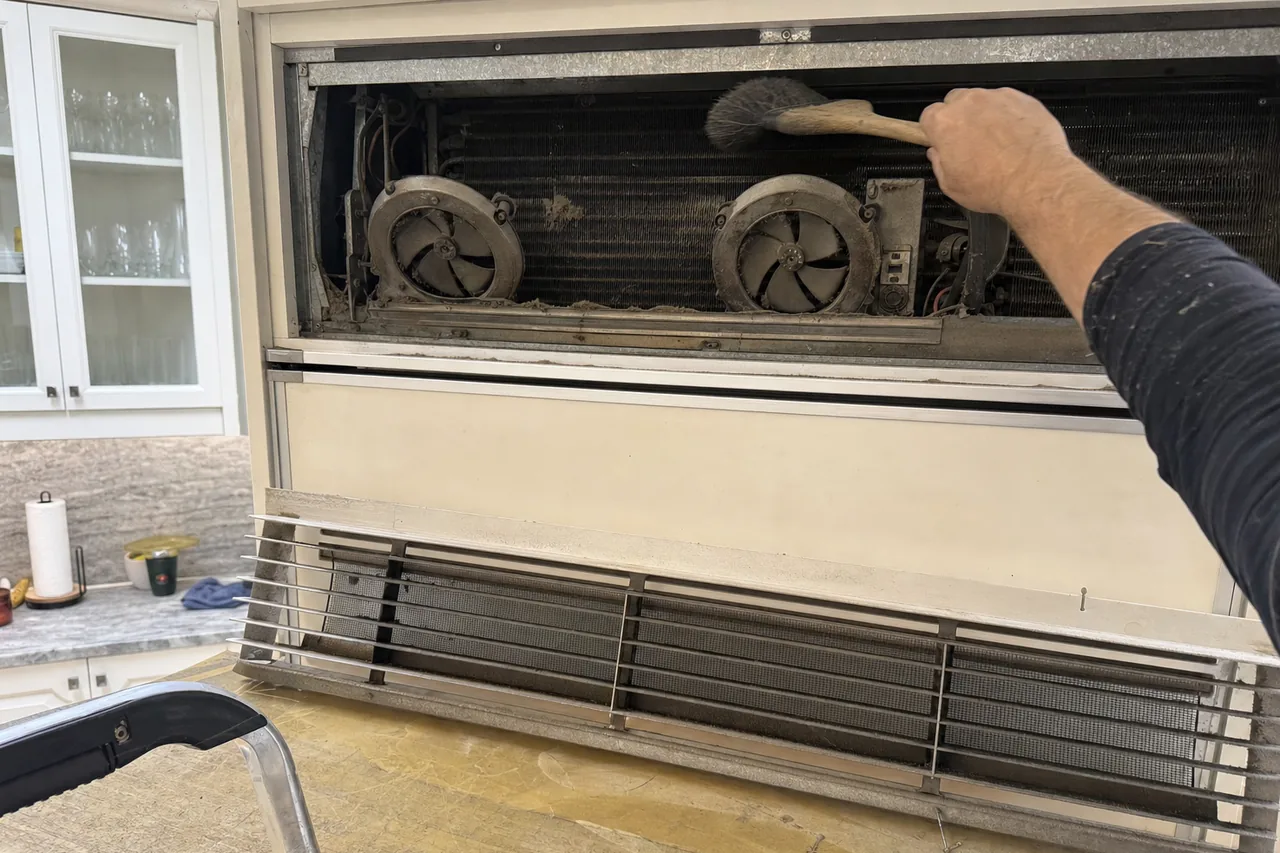
Built-in refrigeration is the appliance a kitchen is designed around, and it is the one that cannot wait. A column that has lost the fresh-food side is a same-week call, not a same-month call, and the first thing we ask is whether the freezer is still holding — because the answer splits the diagnosis in half before anyone opens the door.
| Freezer | Fresh food | Almost always |
|---|---|---|
| Cold | Warm | Air path — evaporator fan, damper, or a frost-blocked outlet |
| Warm | Warm | Sealed system, compressor, or the control that starts it |
| Cold | Cold, cycling badly | Control thermistor or a door not sealing |
| Frosting heavily | Cold | Defrost circuit, or a breached gasket letting humid air in |
That single question routes most of the work. A warm fresh-food compartment with a hard-frozen freezer is a moving-air problem in nine cases out of ten, and moving-air problems are ordinary parts. A cabinet that is uniformly warm with a running compressor is a sealed-system question, and sealed-system work is regulated: our technicians hold EPA Section 608 certification, refrigerant is recovered rather than vented, and we say plainly when a repair is not worth the cost of the equipment.
Every frost-free cabinet grows ice on the evaporator by design and melts it off on a schedule. When the schedule stops running, the ice sheet thickens until it blocks the air the fan is trying to push, and the first complaint is a warm upper compartment — not a frozen coil, because nobody looks behind the back panel. We pull the panel, photograph the frost pattern and read it: even frost across the whole coil says the defrost heater or its bimetal has opened, frost only at the return side says an air leak, and a clean coil with a warm cabinet sends us somewhere else entirely.
The ice maker generates more calls than any other single component in a built-in cabinet, and it is also the one most often replaced when it did not need to be. There is a sequence, and following it costs a few minutes.
First the supply: pressure and flow at the inlet, and the screen out of the valve. A surprising number of dead ice makers are a partly closed saddle valve or a line kinked behind the cabinet when it was last pushed back. Second the fill, timed against the cycle rather than eyeballed, because an over-fill and an under-fill produce completely different cube faults. Third the mold thermostat and the harvest heater, read cold for resistance — a mold that never reaches harvest temperature will hold perfectly good cubes indefinitely and look like a mechanical failure. Fourth the ejector and its module. Only then the shut-off arm or the optical sensor that decides whether the machine believes the bin is already full, which is the fault that most often gets a module condemned by mistake.
Where the cabinet has a dispenser, the door chute and its flap belong in the same sequence: cubes that fuse in the bin are frequently a chute that is not sealing and letting warm room air up into it, not a fault in the maker at all.
In 32080, 32084 and 32082 the condenser is the part that ages fastest. Salt aerosol settles in the fin pack behind the grille, holds moisture against aluminium and copper, and the coil loses its ability to reject heat long before anything sounds wrong. The unit answers by running longer, which reads on the bill before it reads on the thermometer. Hinges, screws and the stainless surround pit in the same air.
For a house within sight of the water, pulling the base grille and vacuuming the condenser twice a year is the highest-value thing an owner can do without tools. We show you where it is on the first visit.
A built-in that no longer lines up with the cabinet fronts is usually not the appliance. Cam hinges wear, but so do the anchoring screws in a cabinet that has moved with humidity. We check the box for square before we adjust anything, because a door forced into alignment against a twisted opening will pull its gasket open at one corner and put you back where you started, sweating and frosting.
Flat $80 diagnostic, credited toward the repair. Written estimate before any part is ordered. Genuine OEM parts, 90 days labour, 365 days parts.
A band, not a single number: the firm figure is written down after the appliance has been opened and measured, and a range is what you can act on before that. Parts and labour together, fitted, for viking built-in and free-standing refrigeration.
| Repair | Typical range |
|---|---|
| Diagnostic visit | $80 flat |
| Refrigeration fan or defrost system | $240–$640 |
| Compressor or sealed-system repair | $970–$2,640 |
| Control board or touch panel | $410–$980 |
Flat $80 diagnostic covering the visit and the full diagnostic sequence, credited toward the repair once you approve the work.A written estimate comes before any part is ordered or any labour is billed. The whole published table. Worth fixing, or worth replacing.
The visit is a flat $80 diagnostic, credited toward the repair once you approve it. The repair itself lands in the bands published on this page — refrigeration fan or defrost system $240–$640; compressor or sealed-system repair $970–$2,640; control board or touch panel $410–$980 — so $80 to $2,640 covers the work described here, parts and labour together. The firm number is written down after the appliance has been measured, never before.
Sealed-system work runs $970–$2,640 fitted, and the compressor itself is only part of that: recovering the refrigerant, making the repair, evacuating the system and putting a measured charge back are the hours. It is EPA Section 608 work, and it is the one repair we will talk an owner out of.
Because the same complaint has more than one cause, and the causes do not cost the same. A written estimate comes before any part is ordered or any labour is billed. If the measurement rules out the expensive end, you see that on the estimate before you decide anything.
90 days on our labour and 365 days on the parts we supply. Genuine OEM parts. A return visit on the same fault inside the term carries no second diagnostic and no trip charge.
Ring the bench and describe the symptom. A question that cannot be answered on the telephone is a question that needs a meter on the appliance, and we would rather say so than sell a visit to find out.
Freezer frosted along one side and the shelves stuck fast. He checked the seal with a slip of paper, found one corner letting air in, and refitted the gasket so it closes evenly across the whole face.
Owen K.2026-04-02
Ice built up along the back wall every couple of weeks. It turned out to be a defrost bimetal, not the control board another company wanted to sell us. The part came on a second visit, which I had hoped to avoid, but the icing has not returned.
Devon P.2026-05-02
The cooling fault was found and put right, and the unit has been steady since. What annoyed me was the wait for the part, which nobody flagged when the visit was booked. Sound work, slow supply.
Greta P.2026-02-11
Flat $80 diagnostic, credited toward the repair when you approve the work. A written estimate comes before any part is ordered or any labour is billed.
90 days on labour, 365 days on parts, genuine OEM parts only. Calls placed after hours are returned the next working morning.