The door glass had fogged between the panes and you could not see a thing inside. He stripped the door, cleaned and reseated the inner glass with new seals and put the whole thing back square.
Petra S.2025-09-16
Independent Viking service · St. Johns County, Florida
$80 diagnostic, credited to the repair
oven
Built-in single, double and speed ovens. Heat control, convection, door latches and the boards that fail behind them.
Reviewed 2026-08-04
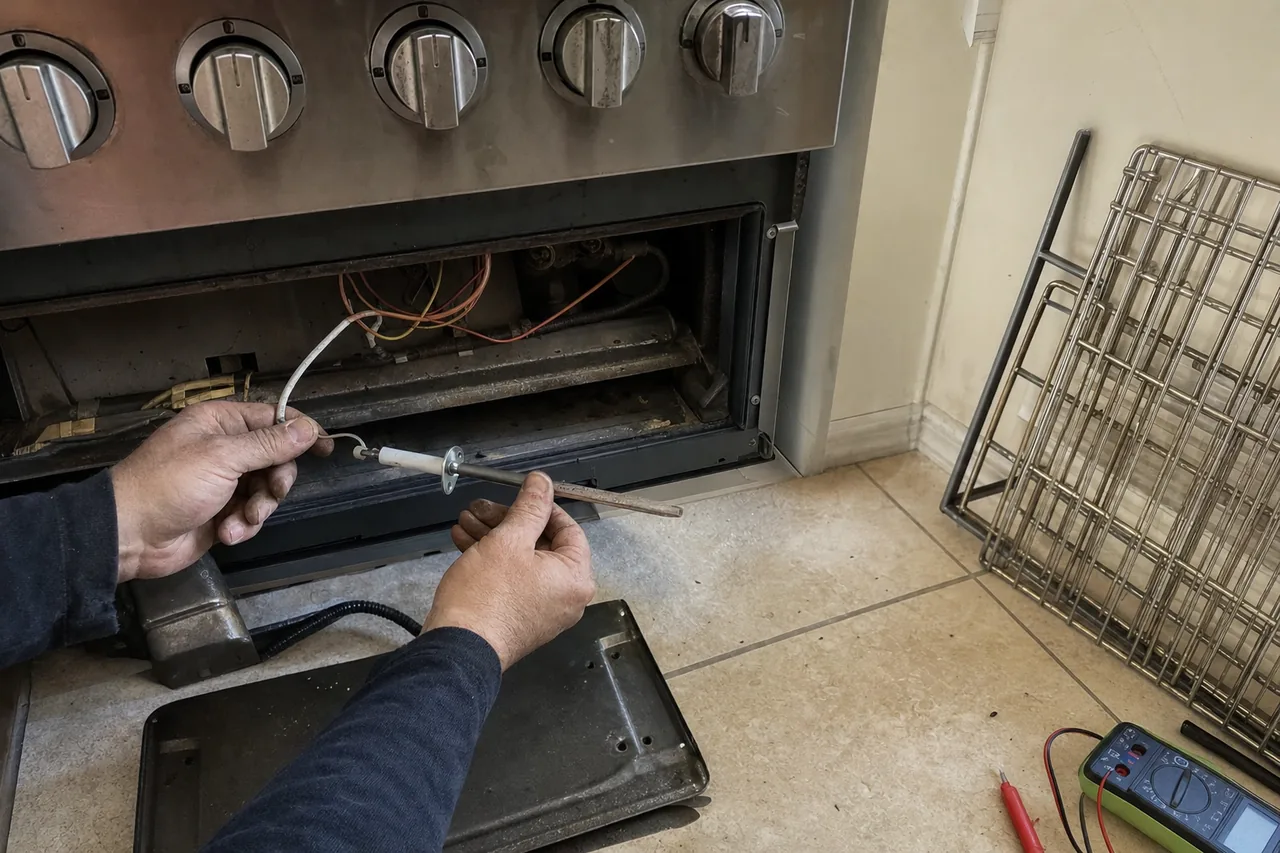
A wall oven is joined to the cabinetry, so every fault has two halves: the electrical problem, and the problem of reaching it. A 30-inch double oven in a tall cabinet weighs enough that pulling it forward is a two-technician job, and the cabinet screws are usually painted over. We plan the access before the truck leaves, which is why the diagnostic visit asks for the model and serial off the data plate on the door frame.
| What you see | Where it usually is | What we measure |
|---|---|---|
| Bakes pale or scorches | Temperature sensor drift, weak element | Sensor resistance cold, cavity probe over three full cycles |
| Slow preheat | One element open or one relay not pulling in | Current on each leg at the terminal block |
| Door locked after self-clean | Latch motor, latch switch, or a tripped thermal fuse | Continuity across the latch switch, fuse checked cold |
| No heat, display alive | Relay board output stage | Voltage at the element with a call for heat present |
| Nothing at all, fan runs | Thermal fuse or supply leg | 240 V across both legs at the block, then the fuse |
| Fan noise | Convection motor bearing or a blade fouling the baffle | Blade end-play by hand with power off |
The oven sensor in a built-in of this class is normally a 1,000-ohm platinum RTD. Cold, at room temperature, a healthy one reads a little above 1,000 ohms, and the resistance climbs steadily as the cavity heats. A sensor that has drifted still reads plausibly at rest and lies badly at 400 F, which is exactly why the complaint is usually described as the oven used to be fine.
We log the cavity with an independent probe through a complete preheat and at least two cycling periods. That distinguishes three different faults that all present as bad baking: a sensor reading low, an element cycling short because a relay contact is pitted, and an oven that is actually accurate but sitting in a cabinet with a blocked vent path. Only the first two are parts.
Pyrolytic cleaning runs the cavity far above cooking temperature for hours. It is the single hardest thing the appliance ever does, and it is the cycle that most often converts a working oven into a service call. The heat migrates into the control pocket above the door, and the casualties are predictable: the thermal fuse opens, the latch motor cooks, the door glass gasket takes a set, and boards that were marginal stop being marginal.
If your oven is more than a decade old and has never been self-cleaned, running it for the first time before a holiday is a gamble. We would rather clean it by hand for you than replace a latch assembly in December.
A combination speed oven is two appliances sharing a cavity. Convection faults are ordinary oven work. Microwave faults are not: the high-voltage capacitor holds a lethal charge after the unit is unplugged, and the door interlock chain is a safety system, not a convenience. We discharge, test, and if the magnetron or the HV components are the answer we quote them as a set. We do not defeat an interlock to make a unit run for a demonstration.
Two local conditions shorten wall-oven life here. The first is storm season — roughly 68 thunderstorm days a year, and surges arrive through the house wiring rather than through the appliance, so the relay board takes the hit while the elements are untouched. The second is downtown and Anastasia Island housing stock from the 1900s to the 1930s, where a wall oven has been fitted into an opening that was cut for something smaller and the required air gaps around the trim were never there. An oven that overheats its own controls will keep failing until the opening is corrected.
Flat $80 diagnostic, credited toward the repair when you approve the work. A written estimate comes before any part is ordered. Genuine OEM parts, 90 days on labour and 365 days on parts.
A band, not a single number: the firm figure is written down after the appliance has been opened and measured, and a range is what you can act on before that. Parts and labour together, fitted, for viking wall oven and speed oven repair.
| Repair | Typical range |
|---|---|
| Diagnostic visit | $80 flat |
| Oven thermostat or heating element | $180–$610 |
| Control board or touch panel | $410–$980 |
Flat $80 diagnostic covering the visit and the full diagnostic sequence, credited toward the repair once you approve the work.A written estimate comes before any part is ordered or any labour is billed. The whole published table. Worth fixing, or worth replacing.
The visit is a flat $80 diagnostic, credited toward the repair once you approve it. The repair itself lands in the bands published on this page — oven thermostat or heating element $180–$610; control board or touch panel $410–$980 — so $80 to $980 covers the work described here, parts and labour together. The firm number is written down after the appliance has been measured, never before.
Three faults look identical from the kitchen: a sensor that has drifted, an element or burner not delivering full heat, and an oven that is accurate but sitting in a blocked cabinet. A probe through a full preheat separates them. Two of the three are parts, at $180–$610 fitted, and the third is not.
Because the same complaint has more than one cause, and the causes do not cost the same. A written estimate comes before any part is ordered or any labour is billed. If the measurement rules out the expensive end, you see that on the estimate before you decide anything.
90 days on our labour and 365 days on the parts we supply. Genuine OEM parts. A return visit on the same fault inside the term carries no second diagnostic and no trip charge.
Ring the bench and describe the symptom. A question that cannot be answered on the telephone is a question that needs a meter on the appliance, and we would rather say so than sell a visit to find out.
The door glass had fogged between the panes and you could not see a thing inside. He stripped the door, cleaned and reseated the inner glass with new seals and put the whole thing back square.
Petra S.2025-09-16
Baking ran hot by a wide margin and cakes were burning underneath. He logged the temperature through three full cycles, adjusted the offset and proved the swing sat inside a sensible band before leaving.
Beatriz M.2026-08-25
The touch panel had gone dead down one column. He replaced the control and reloaded the settings. It works, but I waited a while for the part and the first figure I was given moved a little.
Juniper K.2026-04-29
Flat $80 diagnostic, credited toward the repair when you approve the work. A written estimate comes before any part is ordered or any labour is billed.
90 days on labour, 365 days on parts, genuine OEM parts only. Calls placed after hours are returned the next working morning.