Oven would heat and then quit with no warning. He measured the sensor cold and hot, found it drifting well out of range and replaced it. He also tightened a loose terminal at the back that would have caused worse.
Tobias E.2026-09-08
Independent Viking service · St. Johns County, Florida
$80 diagnostic, credited to the repair
diagnosis
Set point, average and swing are three different numbers. Most bad-baking complaints are a swing problem, and a single thermometer reading cannot see one.
Reviewed 2026-08-12
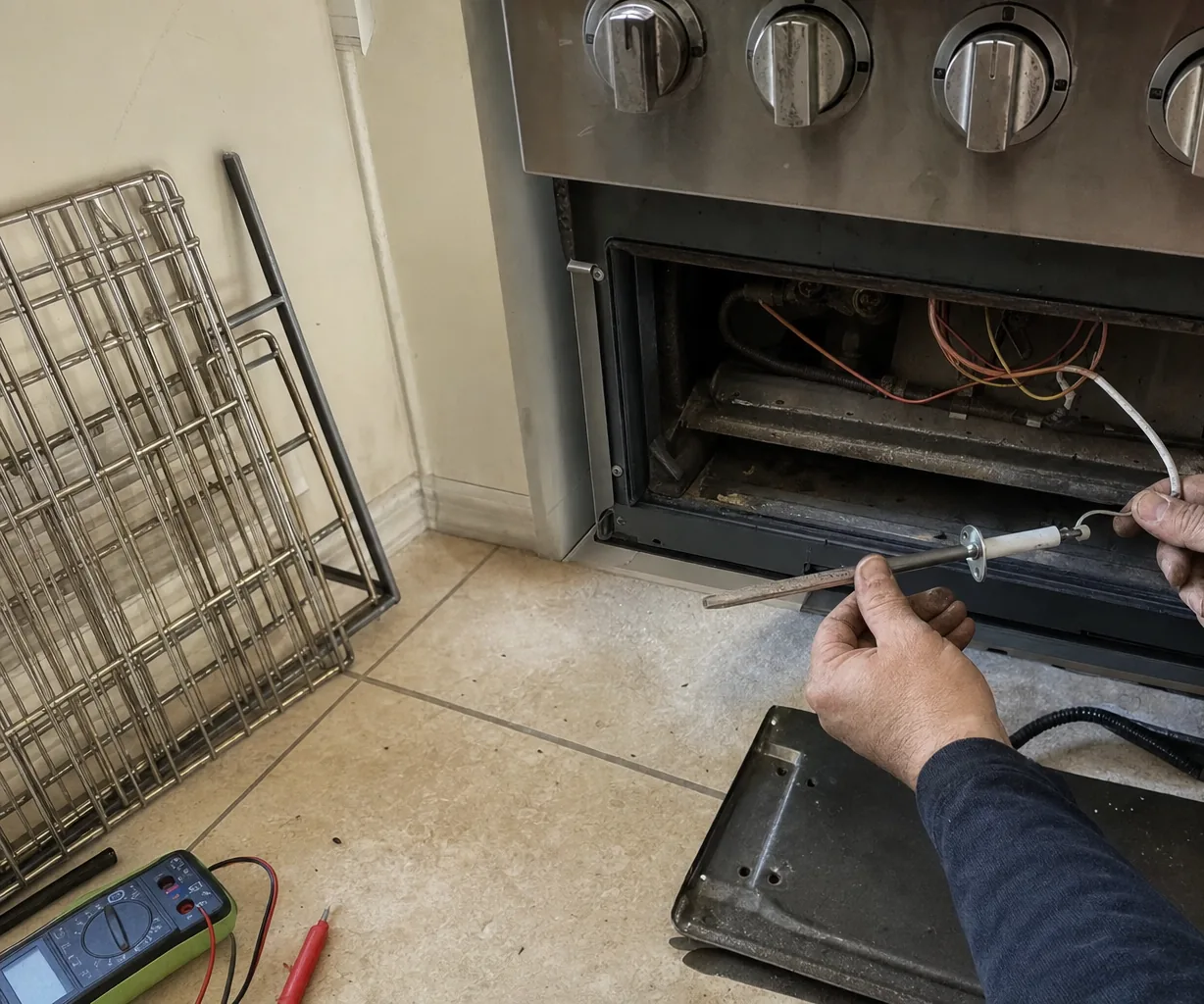
The oven is not accurate any more is the most common complaint we take, and it is the one most often misdiagnosed — by owners, and by technicians in a hurry. The reason is that a single thermometer reading answers a question nobody asked.
An oven has a set point, an average temperature, and a swing. They are independent.
| Number | What it is | What a bad value does to your food |
|---|---|---|
| Set point | What you asked for | Nothing by itself |
| Average | The mean cavity temperature over a full cycle | Everything cooks fast or slow, evenly |
| Swing | How far it rises and falls around that mean | Pale tops, burnt bases, inconsistent results |
Every thermostatically controlled oven cycles. The element or burner comes on, the cavity overshoots the set point, the heat is cut, the cavity falls below, and the cycle repeats. A healthy swing is modest and symmetrical. A wide swing produces exactly the complaint people describe as inaccurate even when the average is dead on the set point — which is why a thermometer glanced at once reads correct while the baking is plainly wrong.
We put an independent probe in the cavity, at rack height, away from the walls and away from the sensor, and we log a full preheat plus at least two complete cycling periods. That takes time and it is the reason our diagnostic visit is not five minutes. It is also the only method that separates three faults that present identically.
Sensor drift. The average sits consistently above or below the set point, and the swing is normal. In a built-in of this class the sensor is usually a 1,000-ohm platinum RTD: cold, at room temperature, a healthy one measures a little over 1,000 ohms, and resistance climbs with temperature. A drifted sensor often reads plausibly cold and lies badly hot, which is why a cold resistance check alone is not proof.
Weak or intermittent heat. The average sits low and the recovery after each cut-off is slow. That is an element with a failing section, a gas valve not opening fully, or a relay contact that has pitted so the element is not getting full voltage every time it is called.
Air path. The average and the swing both look reasonable and the food is still wrong. That points at convection — a fan not turning at speed, a baffle fouled, a blocked cavity vent — or at an installation without the clearance the appliance needs.
Most ovens allow a calibration offset. Applying one to an oven with a wide swing, a weak element or a blocked vent hides the symptom and guarantees the customer comes back. We only adjust an offset once the swing is normal and the fault is a genuine, stable difference between the sensor’s opinion and reality.
Two things make the visit shorter and both cost nothing.
We will not swap a sensor on suspicion, and we will not quote a board because the oven is behaving oddly. Both are common and both are guesses. The log either supports the part or it does not, and if it does not we keep looking. The diagnostic fee is flat at $80 and credited toward the repair, so there is nothing gained on our side by shortening the measurement.
A band, not a single number: the firm figure is written down after the appliance has been opened and measured, and a range is what you can act on before that. Parts and labour together, fitted, for the fault described here.
| Repair | Typical range |
|---|---|
| Diagnostic visit | $80 flat |
| Oven thermostat or heating element | $180–$610 |
| Control board or touch panel | $410–$980 |
Flat $80 diagnostic covering the visit and the full diagnostic sequence, credited toward the repair once you approve the work.A written estimate comes before any part is ordered or any labour is billed. The whole published table. Worth fixing, or worth replacing.
The visit is a flat $80 diagnostic, credited toward the repair once you approve it. The repair itself lands in the bands published on this page — oven thermostat or heating element $180–$610; control board or touch panel $410–$980 — so $80 to $980 covers the work described here, parts and labour together. The firm number is written down after the appliance has been measured, never before.
Three faults look identical from the kitchen: a sensor that has drifted, an element or burner not delivering full heat, and an oven that is accurate but sitting in a blocked cabinet. A probe through a full preheat separates them. Two of the three are parts, at $180–$610 fitted, and the third is not.
Flat $80 diagnostic, credited toward the repair when you approve the work. If you decide not to go ahead, the diagnostic stands on its own and you keep the written estimate, including what was measured and what was ruled out.
90 days on our labour and 365 days on the parts we supply. Genuine OEM parts. A return visit on the same fault inside the term carries no second diagnostic and no trip charge.
Ring the bench and describe the symptom. A question that cannot be answered on the telephone is a question that needs a meter on the appliance, and we would rather say so than sell a visit to find out.
Oven would heat and then quit with no warning. He measured the sensor cold and hot, found it drifting well out of range and replaced it. He also tightened a loose terminal at the back that would have caused worse.
Tobias E.2026-09-08
The griddle plate never came up to an even temperature. He calibrated the control, cleaned the underside of the plate and explained the limits of the module. Improved, though still not flat right across.
Leland U.2026-07-02
Simmer on the rangetop had turned into a full boil wherever the knob sat. He rebuilt the valve with an OEM kit instead of pushing a whole new cooking surface on us, and low heat holds steady where it is set now.
Nadia A.2026-03-04
Flat $80 diagnostic, credited toward the repair when you approve the work. A written estimate comes before any part is ordered or any labour is billed.
90 days on labour, 365 days on parts, genuine OEM parts only. Calls placed after hours are returned the next working morning.